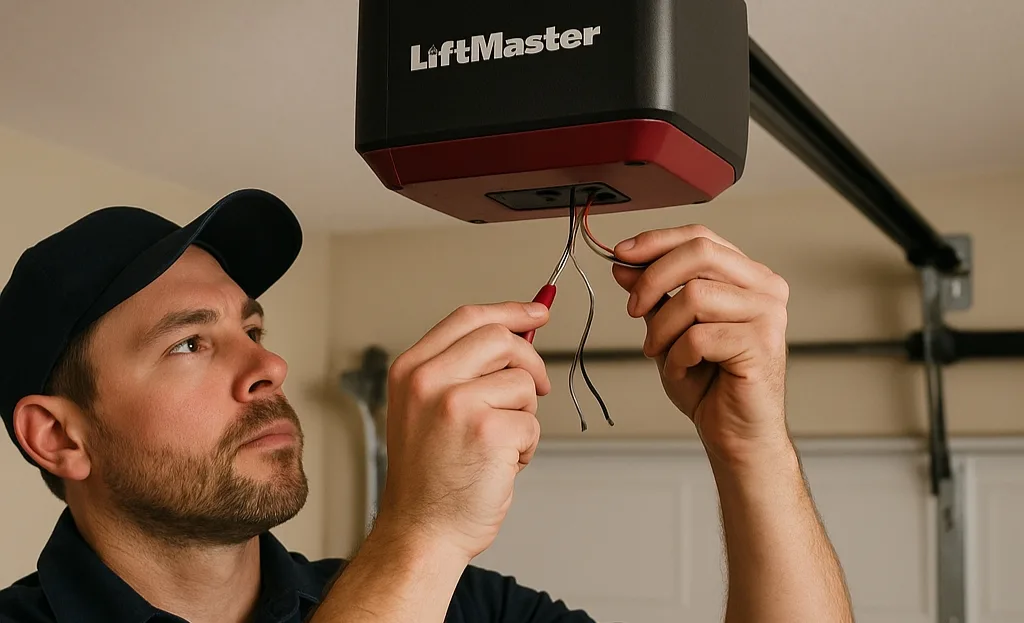
Garage Door Opener Repair: Why Your Door Won't Close All the Way
If your garage door will not close all the way, the most common cause is a misaligned or blocked safety sensor near the floor. Other frequent causes are travel-limit settings that are out of adjustment, a binding track, or a worn opener that misreads the door's position. Start with the quick checks: look for a blinking light on the motor unit, wipe the two sensor lenses and make sure they point straight at each other, and clear any debris from the tracks.
A door that will not close is more than a daily headache. It leaves your home open and can point to a deeper mechanical fault. Working through the causes in order, from simplest to most serious, is the fastest way to find the real problem. Here is how to do that safely.
Why won't your garage door close all the way?
A door that opens fine but refuses to close, or closes partway and reverses, is almost always reacting to one of four things: the safety sensors, the travel-limit settings, something binding in the tracks, or a failing opener. The good news is that the two most common causes are also the easiest and cheapest to fix. We will take them in order so you do not pay for a repair you do not need. For a wider view, see our guide to troubleshooting common garage door problems.
How do safety sensors stop the door from closing?
Since the early 1990s, every automatic residential opener must have non-contact safety sensors. These photo-eyes sit about six inches off the ground on each side of the opening and send an invisible beam across the doorway. If anything breaks that beam while the door is coming down, the opener stops and reverses. Misaligned or dirty sensors are the single most common reason a door will not close.
How to spot a sensor problem
When the sensors are the cause, the motor unit usually clicks and the overhead light blinks, often about ten times. Check the small LED on each sensor. The sending eye normally glows steady amber or yellow, and the receiving eye glows steady green. If the receiving light flickers or goes dark, the beam is blocked or the eyes are out of line. A bumped bracket, a cobweb, or direct sun on the lens is often all it takes. Wipe both lenses with a soft dry cloth and nudge the brackets until both lights are solid.
Could the travel limits or force settings be off?
If the sensors are fine but the door stops short or hits the floor and bounces back up, the travel limits are likely out of adjustment. The limits tell the opener exactly how far to drive the door before stopping. Daily vibration can let those settings drift over time.
If the down limit is set too high, the door stops with a gap at the bottom. If it is set too low, the opener thinks the floor is an obstruction and reverses. Force settings matter too: if the down force is too low, normal friction in cold weather can trick the opener into reversing. This is why our guide to common cold-weather door problems matters in Colorado. Make small quarter-turn changes to the limit screws and retest after each one.
What about mechanical and electrical failures?
If the easy fixes do not help, the opener itself may be wearing out. Most units last 10 to 15 years.
Stripped drive gears
If you press the button and hear the motor hum smoothly but the belt or chain does not move, you most likely have a stripped drive gear. These nylon gears are made to be the weak link, so they shred before the motor burns out when the door jams. The fix is a gear kit or, on an older unit, a new opener.
Logic board faults
The logic board is the brain of the opener. Power surges, nearby lightning, or simple age can damage it. A failing board may ignore the remote, run erratically, or stop mid-cycle for no clear reason. Replacing a board is a technician job because it involves live electronics and exact wiring.
How do you troubleshoot it step by step?
Before calling for service, work through these checks in order:
- Check the sensor lights. Both eyes should show solid, non-flickering LEDs. Wipe the lenses with a soft dry cloth.
- Clear the tracks. Look for pebbles, hardened grease, or bent metal that could make the rollers bind.
- Test the balance. Pull the red emergency-release cord, then lift the door halfway by hand and let go. If it slams down or shoots up, the springs are the problem, not the opener.
- Adjust the travel limits. Find the limit screws or buttons in your manual and make small quarter-turn changes to the down limit, retesting each time.
- Listen to the motor. Grinding points to a gear or mechanical fault. A click usually means an electrical or sensor issue.
If the door feels very heavy during the balance test, stop. You are dealing with a spring problem, and operating the door in that state is dangerous. Read our pillar on garage door spring repair to understand the risk. If you only lose power, our guide on opening the door manually during an outage walks you through the release cord safely.
Which fixes are safe to DIY, and which need a pro?
Realigning a sensor is something any homeowner can do. Other repairs carry real risk, and OSHA cautions against untrained people handling high-tension parts. The table below sorts the common tasks by who should do them and how long they take. If your remote is the only thing acting up, our guide on a remote that won't work covers the quick fixes first.
How do you prevent future opener problems?
Two short tune-ups a year keep most opener faults from ever happening. Lubricate the hinges, rollers, and springs with a silicone or lithium-based spray. Never use a degreaser like WD-40 on the tracks, because it strips lubricant and attracts grit that makes the rollers bind. A yearly inspection catches a fraying cable or drifting limit before it becomes a breakdown.
If the door still will not close after the basic checks, do not force it. Contact G Brothers Garage Doors for fast garage door opener repair and we will get it working safely again. We serve homeowners across the Denver metro, including Lakewood, Arvada, and Westminster.
Which opener fixes are safe to DIY?
Some checks are quick and low-risk. Others involve high tension or live electronics and should go to a technician.
| Task | DIY or pro? | Risk level | Typical time |
|---|---|---|---|
| Realign or clean safety sensors | DIY | Low | 5 to 10 minutes |
| Adjust travel limits | DIY, with care | Medium | 15 to 20 minutes |
| Replace a logic board | Pro recommended | Medium | 45 to 60 minutes |
| Replace stripped drive gears | Pro | High | 1 to 2 hours |
| Fix unbalanced or broken springs | Pro only | Extreme | About 1 hour |
When in doubt, stop. A door under spring tension can injure you badly if it drops.
Typical garage door opener repair cost
- Sensor realignment / minor fix
- $85 to $150
- Drive gear or belt replacement
- $100 to $200
- Logic board replacement
- $150 to $300
- New opener installed
- $300 to $600
Tens of thousands of garage-door-related injuries are treated in the U.S. each year, which is why a door that will not close correctly should be treated as a safety issue, not just an annoyance.
Source: U.S. Consumer Product Safety Commission (CPSC)
Sources and references
- 1.Garage door safety and injury guidance — U.S. Consumer Product Safety Commission (CPSC)
- 2.Opener and safety-sensor standards — Door & Access Systems Manufacturers Association (DASMA)
- 3.Hazards of high-tension components — Occupational Safety and Health Administration (OSHA)
Explore this guide
- Garage Door Remote Not Working? How to Fix ItIf your garage door remote is not working, start with the batteries. A dead or weak battery is the cause about half the time. If fresh batteries do not help, the issue is likely the sensor, antenna, or a lost pairing.Read guide
- How to Open a Garage Door Manually During a Power OutageWhen the power goes out, pull the red emergency-release cord hanging from the opener rail to disengage the motor, then lift the door by hand. The springs carry the door's weight, so a well-maintained door should rise smoothly and stay open on its own.Read guide
- How to Troubleshoot Common Garage Door ProblemsStart with the simple checks: power, batteries, and the safety sensors. Most common garage door problems trace to a handful of parts, and many are a safe DIY fix once you know what you are looking at.Read guide
Technical resources
Related services
G Brothers provides these services across the Denver metro, from Lakewood and Arvada to Centennial and Thornton.
Frequently asked questions
Why is my garage door opener not working?
Garage door opener not working? Check the power, remote battery, sensors, and travel limits first. Here is what is DIY-safe and what needs a tech.
Read full answerHow do I fix garage door sensors that won't align?
Fix garage door sensor alignment yourself: read the LED colors, clean the lenses, level the brackets, and check the wiring so your door stops reversing.
Read full answerHow much does garage door opener repair cost?
How much does garage door opener repair cost? Most Front Range fixes run $100 to $350 parts and labor. Here is what each opener repair costs.
Read full answerShould I repair or replace my garage door opener?
Should you repair or replace your garage door opener? Repair a newer unit with one failed part. Replace one over 15 years old or missing safety sensors.
Read full answerWhy won't my garage door remote work?
Why your garage door remote stopped working: a dead battery, lost programming, range or antenna trouble, or LED-bulb interference, and how to fix it.
Read full answerHow do I reset my garage door opener?
How to reset a garage door opener: power cycle the motor for a soft reset, or hold the Learn button for a full factory reset, then reprogram your remotes.
Read full answerHave a garage door problem now?
Tell us what your door is doing and we will tell you what is likely wrong and what it costs. Same-day service across the Denver metro.