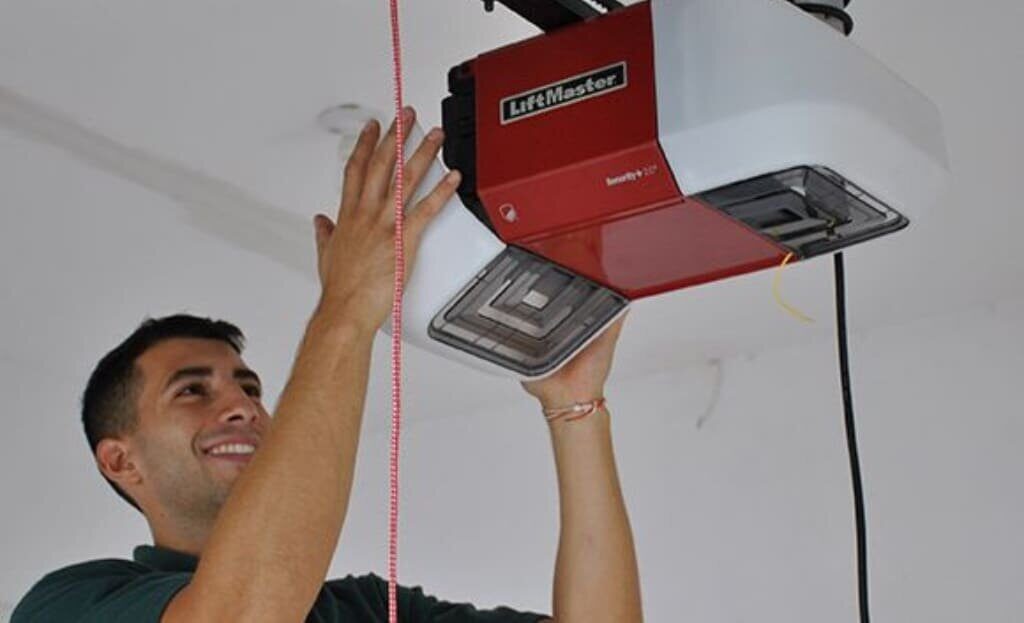
How to Install a Garage Door Opener: What to Know Before You Start
Installing a garage door opener is a manageable DIY project on a standard single-car door, and most modern kits include clear instructions. The two steps that trip people up are the safety sensor alignment and the travel limit adjustment, not the physical assembly. Get those right and the opener will work reliably for years. Get them wrong and the door either will not close or will reverse immediately every time.
What do you need to know before buying an opener?
Two measurements decide what you can install: the headroom above the door and the door's weight. Most standard openers require 10 to 12 inches of clearance between the top of the door in its open position and the ceiling. If your garage has less than that, you need a low-headroom kit or a jackshaft opener that mounts to the side of the door jamb instead of the ceiling.
Door weight matters for the motor's horsepower rating. A standard insulated steel double door weighs about 150 to 200 pounds and works well with a 1/2 HP opener. A heavy wood door needs 3/4 HP or more. Check your door's label or ask the manufacturer. An undersized motor will burn out years early. The comparison table below shows the drive options so you can match the right one to your setup before you buy.
You also need a dedicated, grounded 120V outlet within reach of where the motor unit will hang. If one is not there, have an electrician add one. Running an extension cord to an opener is a safety and warranty issue.
How do you install a garage door opener step by step?
These steps follow the general sequence for a standard ceiling-mounted rail system. Always read your specific model's manual because the bracket shapes and wiring colors vary by brand.
Assemble the rail and motor unit
Lay the rail sections on the garage floor and snap them together following the diagram in the box. Slide the trolley onto the rail before connecting the sections fully, since it will not fit once the rail is complete. Attach the drive (belt or chain) and tension it to the specs in the manual. Tight is not better: an overtightened belt or chain wears out the trolley faster.
Mount the motor unit to the ceiling
Lift the assembled rail and rest the front end on the doorstop above the center of the door. Mount the L-bracket to the header above the door first, then support the motor end with the ceiling straps attached to solid framing, not to drywall. Use a level to confirm the rail runs parallel to the door. A rail that tilts even a few degrees will cause the trolley to bind over time.
Connect the rail to the door
The curved section of the rail rests in the front L-bracket. Connect the door arm to the trolley and to the top center of the door panel. The arm should be adjusted so the door can travel its full range without binding at the top or pulling the panel inward at the bottom.
Mount and align the safety sensors
This is where most DIY installs go wrong. Federal law requires photoelectric sensors on every residential opener made after 1993. Mount one on each side of the door opening, 6 inches above the floor. Both lenses must face each other directly. Run the low-voltage wire up and along the wall to the motor unit terminals, keeping it away from the high-voltage power cord. A solid green LED on the receiving sensor and a solid amber on the sending sensor tells you the beam is clear. A flickering or dark LED means the sensors are out of alignment. Do not skip this check: a misaligned sensor is the most common reason a door will not close after installation.
Set the travel limits
The travel limits tell the opener exactly how far to drive the door up and how far to drive it down. Too far down and the door hits the floor hard and reverses. Not far enough and the door leaves a gap at the bottom. Follow your manual's limit adjustment procedure (usually a small screw labeled Up and Down on the motor unit). Make small changes, test after each one, and confirm the door sits flush with the floor in the closed position without the motor straining.
Program the remotes and test the auto-reverse
Press the Learn button on the motor unit and hold your remote button until the opener light blinks. Then place a 2x4 flat on the floor in the door's path and close the door. The door must reverse when it contacts the board. If it does not, adjust the down-force setting. This test is a legal requirement, not optional. Once it passes, program your wall button and any extra remotes the same way.
When should you hire a pro instead of doing it yourself?
A standard belt or chain-drive install on a single-car door with normal headroom is a reasonable weekend project for someone comfortable with basic hand tools. Call a professional instead if the door is a heavy wood or double door, the garage has low or unusual headroom, the existing wiring or ceiling framing is unclear, or the old opener was wired with non-standard connections. A botched sensor setup or an improperly tensioned spring is more expensive to fix than the cost of professional installation in the first place.
If you're replacing an old opener and the door itself has not been serviced recently, have a tech inspect the springs and cables before the new motor goes in. A new opener on a door with worn springs will burn through the motor faster. We offer opener installation and replacement across the Denver metro. Get a free estimate and we can usually get there the same week, often the same day.
Garage door opener drive types compared
The drive type affects noise, cost, maintenance, and how well the opener handles a heavy door. Pick based on your garage layout and how close the bedrooms are.
| Drive type | Noise level | Installed cost | Best for | Maintenance |
|---|---|---|---|---|
| Belt drive | Quietest | $300 to $600 | Attached garages, bedrooms above or near garage | Low (rubber belt, occasional tension check) |
| Chain drive | Louder (metal-on-metal) | $200 to $450 | Detached garages, heavy wood doors | Low to medium (lubricate chain annually) |
| Screw drive | Moderate | $250 to $500 | Moderate climates, single-car doors | Low (fewer moving parts) |
| Jackshaft / side-mount | Quiet | $500 to $900 | Low-headroom garages, high ceilings | Low (motor mounts to side of door) |
| Direct drive | Quietest | $350 to $650 | Any home, long warranty typical | Very low (motor travels on the rail) |
Prices are typical installed costs including hardware. DIY purchase-only prices run roughly $100 to $200 less.
Typical garage door opener installation cost
- Chain drive (DIY parts)
- $120 to $230
- Belt drive (DIY parts)
- $200 to $380
- Chain drive (pro installed)
- $200 to $450
- Belt drive (pro installed)
- $300 to $600
- Jackshaft (pro installed)
- $500 to $900
A well-installed garage door opener lasts 10 to 15 years with routine lubrication and annual safety checks. Poor installation shortcuts that lifespan considerably.
Source: Door & Access Systems Manufacturers Association (DASMA)
Sources and references
- 1.Garage door opener safety standards — Door & Access Systems Manufacturers Association (DASMA)
- 2.Garage door and opener safety guidance — U.S. Consumer Product Safety Commission (CPSC)
Part of this guide
Complete GuideGarage Door Opener Repair: Why Your Door Won't Close All the Way- Garage Door Remote Not Working? How to Fix ItIf your garage door remote is not working, start with the batteries. A dead or weak battery is the cause about half the time. If fresh batteries do not help, the issue is likely the sensor, antenna, or a lost pairing.Read guide
- How to Open a Garage Door Manually During a Power OutageWhen the power goes out, pull the red emergency-release cord hanging from the opener rail to disengage the motor, then lift the door by hand. The springs carry the door's weight, so a well-maintained door should rise smoothly and stay open on its own.Read guide
- How to Troubleshoot Common Garage Door ProblemsStart with the simple checks: power, batteries, and the safety sensors. Most common garage door problems trace to a handful of parts, and many are a safe DIY fix once you know what you are looking at.Read guide
Technical resources
G Brothers provides these services across the Denver metro, from Lakewood and Arvada to Centennial and Thornton.
Service areas
Local service for this guide
Explore the nearby service page most relevant to this topic.
Frequently asked questions
Can I get a new opener installed without a new door?
Yes, you can install a new garage door opener without replacing the door. Here's when an opener-only upgrade makes sense and what the install involves.
Read full answerHow much does it cost to install a garage door opener?
How much does it cost to install a garage door opener? Most Front Range jobs run $300 to $650 for the opener and labor. Here is what changes the price.
Read full answerHow do I program my garage door opener or remote?
How to program a garage door opener and remote with the Learn button, pair your car's built-in buttons, and fix a remote that won't sync. Any brand.
Read full answerDo you install smart garage door openers?
Yes, we install smart garage door openers with WiFi app control, alerts, and MyQ, Alexa, and Google Assistant support. Here is how the upgrade works.
Read full answerDoes a new garage door come with an opener?
Not always. A new garage door and the opener are usually priced separately. Here's when an opener is included, when to reuse yours, and when to upgrade.
Read full answerHow do I program a garage door keypad?
How to program a garage door keypad: set a PIN with the opener's Learn button, fix one that won't pair, and reset a forgotten code on any brand.
Read full answerHave a garage door problem now?
Tell us what your door is doing and we will tell you what is likely wrong and what it costs. Same-day service across the Denver metro.